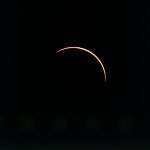
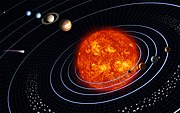
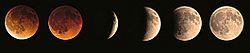
There are four types of solar eclipses:
- A total eclipse occurs when the dark silhouette of the Moon completely obscures the intensely bright light of the Sun, allowing the much fainter solar corona to be visible. During any one eclipse, totality occurs at best only in a narrow track on the surface of the Earth.
- An annular eclipse occurs when the Sun and Moon are exactly in line, but the apparent size of the Moon is smaller than that of the Sun. Hence the Sun appears as a very bright ring, or annulus, surrounding the outline of the Moon.
- A hybrid eclipse (also called annular/total eclipse) shifts between a total and annular eclipse. At some points on the surface of the Earth it appears as a total eclipse, whereas at others it appears as annular. Hybrid eclipses are comparatively rare.
- A partial eclipse occurs when the Sun and Moon are not exactly in line and the Moon only partially obscures the Sun. This phenomenon can usually be seen from a large part of the Earth outside of the track of an annular or total eclipse. However, some eclipses can only be seen as a partial eclipse, because the umbra passes above the Earth's polar regions and never intersects the Earth's surface.
The Sun's distance from the Earth is about 400 times the Moon's distance, and the Sun's
diameter is about 400 times the Moon's diameter. Because these ratios are approximately the same, the Sun and the Moon as seen from Earth appear to be approximately the same size: about 0.5
degree of arc in angular measure.
The Moon transiting the Sun as seen from
STEREO-B on February 25, 2007 at 4.4 times the distance between the Earth and the Moon.
The Moon's orbit around the Earth is an
ellipse, as is the Earth's orbit around the Sun; the apparent sizes of the Sun and Moon therefore vary. The
magnitude of an eclipse is the ratio of the apparent size of the Moon to the apparent size of the Sun during an eclipse. An eclipse that occurs when the Moon is near its closest distance to the Earth (i.e., near its
perigee) can be a total eclipse because the Moon will appear to be large enough to cover completely the Sun's bright disk, or
photosphere; a total eclipse has a magnitude greater than 1. Conversely, an eclipse that occurs when the Moon is near its farthest distance from the Earth (i.e., near its
apogee) can only be an annular eclipse because the Moon will appear to be slightly smaller than the Sun; the magnitude of an annular eclipse is less than 1. Slightly more solar eclipses are annular than total because, on average, the Moon lies too far from Earth to cover the Sun completely. A hybrid eclipse occurs when the magnitude of an eclipse changes during the event from smaller than one to larger than one—or vice versa—so the eclipse appears to be total at some locations on Earth and annular at other locations.
Because the Earth's orbit around the Sun is also elliptical, the Earth's distance from the Sun similarly varies throughout the year. This affects the apparent sizes of the Sun and Moon in the same way, but not so much as the Moon's varying distance from the Earth. When the Earth approaches its
farthest distance from the Sun in July, a total eclipse is somewhat more likely, whereas conditions favour an annular eclipse when the Earth approaches its
closest distance to the Sun in January.


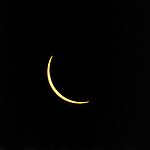
 Under normal conditions, the Sun is so bright that it is difficult to stare at it directly, so there is no tendency to look at it in a way that might damage the eye. However, during an eclipse, with so much of the Sun covered, it is easier and more tempting to stare at it. Unfortunately, looking at the Sun during an eclipse is just as dangerous as looking at it outside an eclipse, except during the brief period of totality, when the Sun's disk is completely covered (totality occurs only during a total eclipse and only very briefly; it does not occur during a partial or annular eclipse). Viewing the Sun's disk through any kind of optical aid (binoculars, a telescope, or even an optical camera viewfinder) is extremely hazardous and can cause irreversible eye damage in a fraction of a second.
 Glancing at the Sun with all or most of its disk visible is unlikely to result in permanent harm, as the pupil will close down and reduce the brightness of the whole scene. If the eclipse is near total, the low average amount of light causes the pupil to open. Unfortunately the remaining parts of the Sun are still just as bright, so they are now brighter on the retina than when looking at a full Sun. As the eye has a small fovea, for detailed viewing, the tendency will be to track the image on to this best part of the retina, causing damage.