


There are three types of lunar eclipses: penumbral, when the Moon crosses only the Earth's penumbra; partial, when the Moon crosses partially into the Earth's umbra; and total, when the Moon crosses entirely into the Earth's umbra. Total lunar eclipses pass through all three phases. Even during a total lunar eclipse, however, the Moon is not completely dark. Sunlight refracted through the Earth's atmosphere enters the umbra and provides a faint illumination. Much as in a sunset, the atmosphere tends to more strongly scatter light with shorter wavelengths, so the illumination of the Moon by refracted light has a red hue,
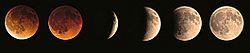
thus the phrase 'Blood Moon' is often found in descriptions of such lunar events as far back as eclipses are recorded.

No comments:
Post a Comment